
Join the Pinyon Jay Party
By: Rebecca Stephenson
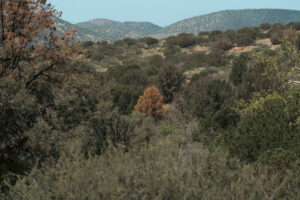
Pinyon Jays aren’t your typical jays. They are small and crest-less, dusky rather than bright blue, and possess long, dagger-like bills. They also issue loud, nasally calls, which has earned them the nickname of “blue crow.” A species of the open West, Pinyon Jays live in pinyon-juniper woodlands from Baja California to Montana – all in all inhabiting these drought-adapted, mid-elevation forests in 13 U.S. states.
Unlike their cousins the scrub-jays, Pinyon Jays travel in large flocks comprised of anywhere from 50 to over 500 birds year-round. In fact, the easiest way to find them is to listen for their distinctive calls and look for their acrobatic flocks, in which birds fly from the back to the front in a rotating pattern. They also spend quite a bit of time strolling along the ground, leaping over each other, and poking around in the soil. There’s a reason a flock of jays is called a “party” or a “ruckus,” after all.
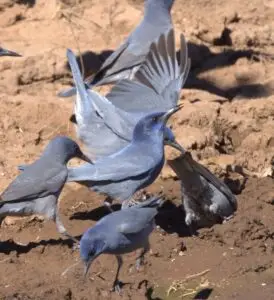
Although they have a reputation for being nomadic, individual flocks stick pretty close to their home forests and only venture far and wide when food is scarce. “In anything except the most dire circumstances, flocks will stay loyal to their home range not only over the year, but for years and decades on end,” says John Boone, research coordinator of the Great Basin Bird Observatory (GBBO). “But within their home ranges, they’re moving around constantly.” Of course, these home ranges are quite large – sometimes up to 2,400 acres.
Pinyon Jays are true “birds of a feather.” “They’re probably the most social bird in North America,” explains Dr. Russell Benford, a wildlife manager and former biology professor who spent years researching Pinyon Jay social dynamics and molecular ecology at Northern Arizona University (NAU) under Dr. Russell Balda, who is widely considered the godfather of Pinyon Jay research. “They rely on their flock dynamics for just about everything they do. They rely on familial dynamics within the flock, but also within their own family.”
Flock members are fiercely loyal to one another, typically spending their whole lives within the one they hatched in – even when it comes time to find a partner. “Pinyon Jays are monogamous for life,” explains Benford. “They’ll pair up usually in their second year – sometimes third year – and they will stay with that mate come hell or high water until that mate disappears.” The jays usually select partners close in age, and despite their best efforts, researchers could not get them to cheat! Says Benford, “I experimented to see if I could force infidelity on them by separating a mated pair and putting them with different opposite sex individuals, then playing a little Barry White music to see what happened. And I could not get them to be unfaithful to their partners. Their social monogamy is strong.”
This isn’t to say that they won’t disperse when necessary, and when they do, it’s usually young females seeking out older, more experienced males in neighboring flocks. “Almost all of your breeding opportunities, your social opportunities, come from your home flock,” explains Benford, who surveyed the genetics of around 3,200 Pinyon Jays in nine Flagstaff flocks in the 2000s. “And this is still hundreds of birds! You’ve got plenty to pick from so you’re not inbreeding. But the flocks are genetically distinct and, according to evidence we can pull out of the genetics, it suggested that there were only a few dispersers among flocks per year.”
Pinyon Jay flocks also have a clever trick for surviving the winter. While they are opportunistic omnivores, the fatty seeds of pinyon pines (the same as those delicious pine nuts we buy for our pesto) are critical for Pinyon Jays. In late summer and fall, they spend most of their time foraging for these delicacies in noisy flocks, probing their bills into green cones to extract the seeds, loading up their expandable esophaguses with up to 56 at a time, and then flying with bulging throats to thousands of cache sites buried in the ground or in tree crevices for long-term storage. In fact, their genus name, Gymnorhinus, translates to “naked nose” – a reference to their lack of the nostril-protecting feathers found in other jays and a helpful adaptation that prevents a build-up of sticky sap as they forage.
While most birds relocate to find more favorable environments when food supplies dwindle and conditions get harsh, Pinyon Jays stay on their home range year-round, living off their stored caches of pine nuts. Consuming the pine nuts is also a trigger for nesting, and the birds will only breed in years when adequate seeds have been stored. If a late summer cone crop is especially robust, they may even raise two clutches.
“One thing that’s interesting about them is they nest much earlier than other birds,” says Madison Lutes, a field technician who surveyed the jays in northern Arizona and New Mexico during their 2026 breeding season. “A lot of other birds will start in the spring, but the Pinyon Jays will start in the winter when it’s still cold out and they are pretty much fledged by the time other birds start nesting. They line their nests well to keep warm.”
These unusual jays are also social when it comes to nesting, raising young in close-knit colonies – sometimes even with several nests in a single tree. There is also evidence that they breed cooperatively, meaning young, unmated birds will help raise their tiny relatives. Nest sites are typically chosen in locations where pinyon pines are known to produce abundant cones, but, as is the case with most things in nature, it’s not always that simple.
Another student of Dr. Balda’s, whose name you might recognize, is Dr. Diana Gabaldon (yes, the same one who wrote the hit book and TV series, “Outlander”). Before she penned Claire and Jamie’s epic story, she spent years researching Pinyon Jay nest site selection at NAU for her Ph.D. in the ‘70s, and one of the questions she confronted was how the jays choose ideal trees for nesting. “I said, ‘If I were a Pinyon Jay, what kind of tree would I pick?’,” she posits, adding, “Apparently no one had thought of the issue in quite that way, but I am a novelist, after all (and therefore used to imagining myself into all kinds of unlikely situations).”
She and her team of grad students surveyed and photographed a large selection of trees in the surrounding habitat – some that would become nest trees and some that wouldn’t – and presented the photos to fellow Pinyon Jay researchers to choose which ones would be best for nesting. “We got something like an 85% recognition rate,” Gabaldon explains. “The grad students knew what a good nest tree looked like! Ergo, we might reasonably hypothesize that so did a Pinyon Jay. This, oddly enough, was the result that Dr. Balda found most exciting: That I’d used one species to deduce the observations and behavior of a different species – without said observers actually looking at the species whose behavior they predicted, but only on their own behavior.” Pinyon Jays, as it turns out, are not so different from us when it comes to house shopping.
Another mystery Gabaldon’s research solved was what the jays were feeding their chicks.
“The first (good) question I came up with was: ‘Do we know for a fact that the adults are feeding pinyon seeds to the babies?’,” she explains.
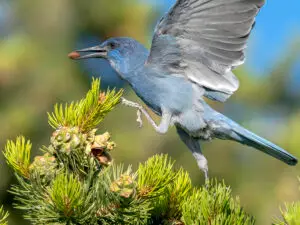
Maresa Pryor-Luzier_Audubon Photography Awards
Like all young birds, Pinyon Jay chicks require lots of protein. But where do they get it? Pinyon nuts are good for sustaining the adults, but not nutrient-dense enough to nourish rapidly growing youngsters. After a careful examination of many chicks’ crop contents, she arrived at an answer. “Lo, and behold! The adults were eating pinyon seeds from the fall (and burying more) – but they weren’t feeding the kids any pinyon seeds; they were feeding the kids insects! Which makes all kinds of sense, because bugs have a much bigger percentage of protein and interesting trace minerals than the seeds do.”
As tends to happen with scientific inquiry, this then introduced another mystery: Where were they getting all those insects in the middle of winter? “I grew up in Flagstaff,” says Gabaldon. “I knew exactly what happened in winter and spring – slush. But the important point is that said slush is pushed or runs off to the sides of roads, where it melts. And when you get water soaking into the ground, you get weeds springing up. It’s plain (if you’re paying attention) that the first place you see any spring growth in Flagstaff is in the roadside ditches and verges – because the water goes in there first. Aaannnddd … if you got plants, you got bugs. So, I did net-sweeps along the verges, and sure enough – tons of juicy bugs!” Among her many hypotheses for why Pinyon Jays preferred to nest along roads – which included traffic acting as a predator deterrent and reliable access to road kill – this handy source of winter insects fit as the most logical explanation.
Being a member of Corvidae (the bird family that also includes ravens and crows), Pinyon Jays are also highly intelligent. They have been observed following flock mates and hijacking their caches, engaging in trickery, and even solving complex puzzles to find treats (Benford says Honey Nut Cheerios became a favorite). “I would put a naïve bird in the cage next to them and have them watch,” says Benford. “So, I studied the social dynamic of watching and learning from their flock mates. And it turns out they learn very quickly and readily. They’ll pick out, like, ‘This guy over here, this is how he’s opening that puzzle box and, look, he’s getting some tasty pine nuts as a reward. I want pine nuts as a reward and I’ve got a similar looking box.’” Put simply, paying attention to what their flock mates are doing pays off. This skill also comes in handy when mates need to retrieve each other’s caches during incubation.

Much to the chagrin of researchers, flocks will also post look-outs to guard nesting areas. “They’re quite smart birds, and they know what you’re doing much faster than you know what they’re doing,” says Boone. “Sometimes it’s fun to try and outsmart them to get a good vantage point without them changing what they’re doing because you’re annoying them. Different birds have different jobs at a given point in time, and they have what are called sentinel birds and sometimes you’ll be trying to kind of creep up and then you’ll look up and there’s the sentinel bird just looking at you and letting the rest of the flock know if you get too close or are too noisy. They’re very personable and very smart birds.”
If this doesn’t work, they have even been observed using distraction tactics to keep researchers from finding their nests. “They would kind of know if you’re watching them and they wouldn’t want to lead you to the nest and sometimes they could try to trick you and lead you away,” says Lutes. “They would fly away from the nest and land and they would be yelling really loud to try to draw your attention to them instead of the nest.” Things get more complicated when their equally-intelligent cousins, the ravens – a top nest predator – also try to use researchers to find nests for more nefarious reasons. Of course, all of this savvy also makes Pinyon Jays notoriously difficult to catch for tagging and monitoring.
Intelligence and social behavior aside, a penchant for pinyon nuts is perhaps the most defining characteristic of this species, which is closely associated with both pinyon pines and pinyon-juniper woodlands as a whole. In fact, they are a keystone species of this biome, meaning the jays are instrumental in keeping the woodland – and all the other species that rely on it like the Juniper Titmouse, Grace’s Warbler, and pinyon mouse – alive and thriving. While Pinyon Jays have excellent spatial memories and can recall up to 95% of their seed storage sites, forgotten caches will eventually germinate into new stands of pinyon pines, ensuring the future of this unique woodland. “There’s a coevolution there,” says Boone. “They are one of – if not the biggest – seed planter for pinyon pines, so their activities certainly structure that landscape.” But, as we humans continue to alter the land and influence climate patterns, it’s a future that is becoming increasingly uncertain.
It’s impossible to consider the Pinyon Jay’s continued survival without acknowledging the struggles of its namesake tree, the pinyon pine. Several species and hybrids of pinyon occur across the West, and all are essential for the jays. But pinyons are not your typical trees. These pines are notoriously long-lived (the infamous Methuselah tree is a close cousin) and they don’t produce cones until they are 25 to 35 years old. “Pinyon pines are sort of an interesting tree in that they tend to be most likely to produce pine nuts in their middle age,” Boone explains. “They don’t do it so much when they’re young, typically it drops off as they get older, but there’s sort of a sweet spot in middle age where they tend to be the most productive.” This means that Pinyon Jays need a continuous supply of healthy, middle-aged pinyon pines to feed and successfully nest – uniform forests won’t reliably bear cones.
Pinyon pines are also mast trees, meaning that every four to eight years they produce an abundance of seeds. Pinyon Jays are quick to take advantage of these bumper crop years, caching as many pine nuts as possible. Because of this ability to plan for hardships ahead, they are also able to weather years when the pines are less productive. The trouble is, those really good years are becoming few and far between. “Mast years can have so many pine nuts that it would be impossible for wildlife to use even a small fraction of them,” says Boone. “But most years, they’re much more sporadic on the landscape. And, in some years, they’re downright scarce.”
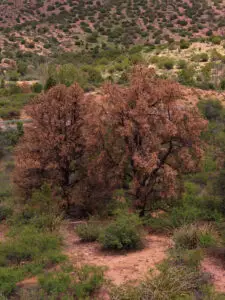
For decades, pinyon-juniper forests have been treated as a wasteland with little economic value, frequently cleared to make way for urban development or altered to create favorable grazing lands for cattle. Only recently have researchers begun to see the effects of this harsh and careless treatment on the Pinyon Jays. The combined impacts of habitat loss for development and resource extraction, tree-thinning for grazing and fire suppression, and climate change have degraded the quality of pinyon-juniper woodland across most of the jays’ range. Climate change is especially devastating, as it causes prolonged drought. Drought-stressed trees not only produce fewer cones, but they are less resistant to pinyon engraver beetles (Ips confusus), which bore into their wood.
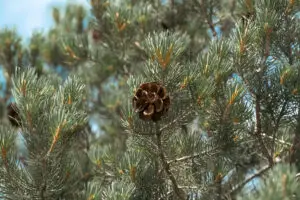
Engraver beetles are native to the pinyon-juniper ecosystem, and pinyon pines have evolved an effective way of fighting them off: Producing sap tubes to stop their tunnels from advancing. But in extreme drought conditions, the weak and stressed trees are not able to produce as much sap and so lose the fight more often. This is why you will see entire stands of dead pines across much of the West. Dead trees also serve as extra fuel that contributes to more devastating wildfires, which are becoming increasingly frequent and severe as a result of climate change.
Fire is a big issue for the jays, as they rely on pinyon pines old enough to produce cones. “Fire is hitting us hard right now here in Sante Fe, we have a huge fire that’s almost to 8,000 acres,” laments Cathy Wise, Senior Manager for Community Building at Audubon Southwest, in August 2026. “And that area that’s burning is Pinyon Jay habitat.” All of this translates to fewer pine nuts each year – and fewer pine nuts means fewer jays.
Though the total acreage of pinyon-juniper woodland has actually increased in recent years, the jays’ numbers have not followed suit. It’s estimated that the Pinyon Jay population has declined by up to 85% in the last 40 years, making these jays one of the most imperiled bird species in the U.S. Flocks that once numbered in the thousands are now down to fewer than a hundred birds. Unfortunately, this trend is expected to continue, with another 50% reduction likely by 2035.
Despite a seeming abundance of adequate habitat, the jays’ decline indicates that there’s more to the story. “Pinyon Jays have been declining for decades but, at least in a superficial way, the habitats that they use aren’t declining in the same way,” explains Boone. “They may be changing in good and bad ways, but they’re not declining. So, it’s not simply that we have only 15% of the Pinyon Jays we once did because we have only 15% of the pinyon-juniper woodlands that we once had, it’s something much more complicated than that. And Pinyon Jays are an unusual species with a relatively complex natural history.”
This means that simply leaving a few pinyon pines intact isn’t enough. “I guess they’re pretty picky about the ratio of trees and I guess it has to be just right,” explains Lutes. “The perfect habitat for them is declining and there are other areas that have pinyon pines but aren’t what the Pinyon Jays prefer. They’re declining but then they’re choosing not to go to areas where they could go because they don’t have a preference for it.”
In addition to these specific habitat requirements that are not yet fully understood, the jays also seem to prefer the transitional zones at the edges of woodlands to the dense centers. The overall quality of the forests – and the presence of mature, healthy pinyon pines – is therefore essential to their continued survival. “Pinyon Jays exist on the landscape in flocks,” says Boone. “Sometimes you’ll see an individual or a pair, but there’s always going to be a flock nearby. So, the unit of occurrence on the landscape is a flock. If it’s true that pine nut production has declined, and it’s true that in a very poor year for pine nut production now there’s far fewer pine nuts to be had than there were 50 years ago during a bad year, that’s a perfectly consistent explanation with smaller flocks.”
For a bird so noticeable, noisy, and seemingly numerous, Pinyon Jays have been surprisingly overlooked when it comes to conservation efforts – but that is changing. Researchers are already hard at work trying to help the species. They have identified key portions of the habitat that must be preserved (such as middle-aged, cone-bearing trees and known nest sites), are working to develop more drought-resistant pinyon pine varieties, and have explored irrigating existing pinyon stands to encourage cone production in extreme droughts.
Efforts are also being made to manage pinyon-juniper woodlands with the jays in mind, including planting native grasses to retain moisture, using straw berms to funnel rain to pinyons, and anticipating what stands of trees will be most useful in the future as climate patterns shift. In 2004, the Pinyon Jay was listed as Vulnerable on the IUCN Red List. Defenders of Wildlife also petitioned to add the jay to the Endangered Species List in 2022, which would secure additional funding and make all of these solutions more likely to succeed. This designation is still pending approval.
In the meantime, we must continue to learn more about the current range of this historically overlooked species. And that’s where you come in! Because Pinyon Jay flocks travel miles each day, it helps to have more eyes and ears scanning the vast landscape for them. They aren’t as easy to survey as, say, a territorial breeding songbird that stays in one spot. The GBBO hosts a community science initiative that aims to log sightings of the jays, as well as quick notes about their behavior. This can help researchers get a better idea of where they are and how they are using different habitats – all data that can help them in the long run.
“One of the relatively unique things about the community science protocol is that it asks the observer to record not only where they are, but what they’re doing there,” says Boone, who helped develop the initiative and its app. “Are they foraging on the ground? Are they resting up in the trees? Being able to sort out the habitat needs for these different phases or elements of their life history will help us to understand what may be most responsible for their declines and suggest what we can potentially (hopefully) do about it.”
Though Phoenix isn’t in the Pinyon Jay’s range, anyone traveling to higher elevations to escape the heat in summer or find snow in winter can participate. “I think the outreach potential is huge, especially for people in the Phoenix Valley that are going on vacation,” says Wise, who adds that you don’t even have to see a jay for your data to matter. “If you’ve been there for 20 minutes and you haven’t seen or heard a Pinyon Jay and you know it’s really good habitat and they should be there, you can submit that record.”
To participate, type “Pinyon Jay Community Science Hub” into your search engine of choice. Then click “Sign Up” and follow the steps to create an account. Once that’s done, you’ll click “Collect Data” and follow the prompts to get approved, learn the ropes, and download and install the free, user-friendly Survey 123 app made by ESRI and tailored to collect data on the jays.
While the outlook may seem bleak, Pinyon Jays are remarkably intelligent birds, and have already demonstrated an ability to adapt to changing conditions. In non-mast years, for example, flocks will travel into new areas searching for pinyon seeds and other foods in fall and winter, even venturing into sagebrush flats, streamside groves, and urban areas. “The trajectory isn’t good,” says Benford. “The ponderosas and pinyons are sort of retreating uphill where the air is a little bit cooler and we’re going to see that probably over the next few generations. But will that be the end for Pinyon Jays? I doubt it.”
“There’s a foundational theory among folks who study the evolution of intelligence and that’s that the reason organisms invest so heavily and put so much energy into such specialized neurophysiology and regular physiology is to support a brain that is capable of decision-making and memory and recognition,” Benford elaborates. “It is probably true that all of that investment is made because environments are complex and changing. And a neurological system that allows for real-time acclimatization and real-time problem-solving helps Pinyon Jays thrive in a world that is not very predictable. So, I tend to have a pretty optimistic perspective toward Pinyon Jay conservation relative to the conservation of other species that aren’t equipped with such magnificent tools.”
There is also evidence to suggest that some populations have started relying more on ponderosa pine seeds, acorns, and juniper berries as a food source. “It’s not a bird that’s going to stay there until it dies,” says Wise. “It’s going to roam, and they can go pretty far in search of nuts and food.” The research supports this behavioral plasticity. “Dispersal increases during [times] of ecological challenge,” explains Benford, “And so there was greater admixture of individuals among flocks, presumably because they were seeking out better foraging grounds or higher-quality mates that might be in other flocks.”
Luckily, Pinyon Jays also seem to adapt well to life alongside people, frequently visiting feeders – where they prefer peanuts, sunflower seeds, cracked corn, and, of course, pine nuts – and sometimes even nesting in yards with tall trees. The racket of urban life, presence of people, and even barking dogs don’t seem to be huge deterrents. As Gabaldon’s research indicates, roads constructed through the habitat can also serve as a surprising source of insects in winter – perhaps evidence of the jays capitalizing on our existence. “They’re very adaptable in regard to food resources and will steal dog food or other small, grabbable items,” she says.
So, where does all this leave us? “I think the Pinyon Jay and pinyon pine together do a good job at illustrating some of the broad conservation challenges and decisions that we, as caring stewards of nature, have to make and grapple with in the next few years and few generations,” says Benford. “I think that, despite a changing world (which is difficult to control and manage), it is easier to manage our own behaviors and habits and to look to a future where we have a more mindful interaction with nature and all of the species our activities impact.”
The Pinyon Jay’s plight is also crucial to our idea of species and land management as a whole. Much like the human body, we tend to treat the symptom rather than the disease when it comes to ecology. “By understanding Pinyon Jays – who use such a big part of the landscape – better, I think it can help lead to a more holistic vision of how these whole landscapes operate and we can try to manage them in a more integrated way than we have so far,” explains Boone. “The usual pattern is that we tend to take a conservation action for one thing – whatever our priority is – and not look at the bigger picture. So, we look at Pinyon Jays not only as an interesting species, but as a mechanism that can facilitate helping everybody look at these large landscapes they inhabit with that bigger picture in mind.”
The good news is, a lot of people already care. “Overwhelmingly, people love Pinyon Jays and are aware of them even if they’re not bird enthusiasts,” says Benford. There is even an award-winning mead named after them called Oh Hey, Pinyon Jay! With an increased awareness of their plight, proper land management decisions, and some diligent citizen science, we can hopefully get this species (and its habitat) the protection it needs. In a rapidly changing world, Pinyon Jays are the only ones who can keep their unique woodland ecosystem intact. As Benford says, “It gets really groovy out in nature.”
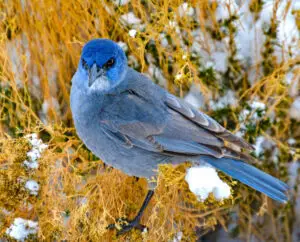
Lyndia Radice_Audubon Photography Awards